Saturday, September 03, 2011

New Tea has arrived!

SEPTEMBER 2011
Finally! We have received our first tea shipment from Japan since the Tohoku Earthquake last March. Although the road to recovery in Japan is still very long; many sectors, including the tea industry, are making progress. Here are some notes on our current tea line-up.


2011 Harvest Teas: We have our new harvest shipment of 2011 tea from Uji (Kyoto) and various areas of Kyushu (Kagoshima, Fukuoka, Miyazaki) now available. With regards to Shizuoka tea, none of the tea plantations from where our teas are sourced experienced radiation problems after the earthquake and tsunami. However, other teas from Shizuoka Prefecture were found to have higher than allowable (per Japanese government standards, but some still with US FDA guidelines) levels of cesium. Therefore, as a precaution, we have decided not to carry any 2011 tea from Shizuoka Prefecture and northward (i.e. Sayama, Saitama Prefecture) until further testing shows all tea from the prefecture to be within compliance. This may be an overreaction, but we would rather be safe than sorry. But, we have purchased some remaining Shizuoka tea from the 2010 harvest. This includes limited quantities of our Chashi Meijin Fukamushicha, Kawane Genmaicha, Asahina Karigane, and Shizuoka Kukicha and Houjicha. Once this inventory is deleted, it will be replaced with 2011 harvest teas from Kagoshima; including Fukamushicha, Kukicha, and Houjicha. If you prefer the 2011 offerings from Kagoshima, they are available now so please make a note in the comment portion of you order and we can substitute on request.

We have also added a new Organic Sencha offering. This Yutakamidori varietal from Yakushima Island in Kagoshima Prefecture is light, with mild sweetness (amami) and low astringency. Since Yakushima is located about 65 km south of Kyushu, some tea farmers there have taken advantage of their relative isolation to encourage organic farming practices. Yakushima is one of the Ousumi Islands of Kagoshima Prefecture and is located about 65 km south of the main island of Kyushu. Much of the island is a UNESCO World Heritage Site, famous for ancient forests of old growth (as much as 1,000 - 4,000 years old!) sugi (cryptomeria) trees. The island is also home to Rhododendron and Yakushima White Pine, as well as the largest nesting ground in the North Pacific for the endangered Loggerhead Sea Turtle. We are very pleased to offer our customers this organic tea option from this magical place!

Lastly, I want to thank all of you who have sent support and kind wishes for continued relief efforts in Japan. Countless individuals and industries across the country are working hard to rebuild lives and livelihoods. We continue to send our thoughts and prayers for a speedy recovery to the tea farmers, potters, colleagues, friends, relatives, and residents of Japan. Many thanks to all of you who are doing the same.

Sunday, May 22, 2011

MAY 2011: I've put together a small concert to generate some funds to forward to the Japan Red Cross. Details of the event to be held on Sunday, June 5th (2 concerts, 1Pm & 7pm) are below. The musicians are both world-class, and the space of a Zen meditation hall in Bellingham, WA will surely be healing. If you'd like to help spread the word, please send me an e-mail and I'll forward the press release and a concert flyer (in your preference of a pdf, pub, or word file) to post or forward to your contacts.


For those of you who live outsde of the Pacific NW area, or who are unable to attend; the CD "Shadows of Time" by the two featured musicians, Gary Stroutsos & David Revelli, is available for purchase on-line at my Charaku website, http://www.charaku-tea.com/teaaccessories4.html. From now through the month of June, 20% of each CD sold will be added to the benefit concert proceeds, of which 100% is being donated to Japan earthquake relief. Gary's CD, "Sacred Clay," featuring the clay instruments of ceramic artist Rod Kendall, is also available on-line, http://www.charaku-tea.com/teaaccessories10.html, and 20% of this recording's sales proceeds will go to the Mashiko Pottery Fund, established just days after the Tohoku Earthquake to help rebuild Mashiko's historic kilns, such as that at the Shoji Hamada Museum (Mashiko Sankokan,) and to help working potters re-establish kilns and inventory damaged by the quake. Shadows of Time, $15.00 / Sacred Clay $10.00; ships first-class in the US for $3.00.


Here are the benefit concert details:


WORLD MUSIC BENEFIT CONCERTS FOR JAPAN EARTHQUAKE / TSUNAMI RELIEF The Red Cedar Dharma Hall in Bellingham will host two benefit concerts for Japan Earthquake/Tsunami relief on Sunday, June 5th at 1:00pm and 7:00pm. Both shows will feature World Flute Artist Gary Stroutsos accompanied by Master Percussionist David Revelli.


Seattle-based Gary Stroutsos is an international performer, composer, and educator whose music is drawn from a variety of world cultures; including Native American, Asian, and American Jazz. His soundtrack work on the Ken Burns "Lewis & Clark" documentary led to a command performance at the White House for President Clinton, and his performance and recording work in sacred spaces has taken him from Buddhist temples in the mountains of central Japan to the depths of New Mexico's Canyon de Chelley National Monument, www.garystroutsos.com.

David Revelli's percussion reperatoire spans Western, Middle Eastern, East Indian, and African instruments. He has been a world-touring percussionist for such well-known names as Sheryl Crow, Jewel, and Mary Chapin Carpenter. He now makes his home in the Pacific Northwest and is a full-time educator. He has returned to the primal sounds of Middle Eastern frame drums and Nigerian clay udus that have complemented the haunting melodies of Stroutsos' flutes in performances around the region, and in their newly released CD, "Shadows of Time." These concerts are sure to insprire compassion, spirituality, and healing. Tickets: $20.00 at the door. All ticket proceeds go to Japan Earthquake relief. Tea will also be served by Charaku Fine Japanese Tea. www.charaku-tea.com.

Advance reservations and further information available at Charaku Fine Japanese Tea

206-660-4189. Red Cedar Dharma Hall is located at 1021 N. Forest Street, Bellingham, WA 98225. Directions: www.redcedarzen.org
APRIL 2011:
To the many friends & customers who wrote or called me after the Tohoku Earthquake and Tsunami of March 11, I give my heartfelt thanks. Many of my relatives are actually located in Miyagi Prefecture, in the cities of Sendai and Natori, near the epicenter of the quake and the region that suffered the most extensive damage. Miraculously, they survived, but it was agonizing not being able to make contact for the first several days. We also have friends in Fukushima, not far from the Daiichi nuclear reactor. A few generations back, my family came from the coastal village of Shizugawa (now Minamisanriku,) which was almost completely erased by the tsunami. Life will certainly be difficult for most in the region for some time to come. Hundred of aftershocks continue to rattle Japan, including one of 7.4 magnitude on April 6. They are all in our thoughts and prayers daily. I know that many of you also have connections to Japan so I understand that this difficult time is being shared by many around the world. My former home of Mashiko in Tochigi Prefecture also experienced widespread damage to many historic and working kilns, as well as the loss of much pottery. The kiln of the late Shoji Hamada was badly damaged at the Hamada Sankokan Museum. This small town is home to a reported 400 kilns and is one of the largest pottery centers in the Japan, and an important site in the contemporary pottery world. The life of a potter is difficult enough, but the loss of inventory and means of production are making it even more so at this time. A link to the newly established Mashiko Potters Fund to rebuild the town’s pottery industry, and those of other relief organizations are listed at the end of this message. I have also heard many inquiries and concerns regarding the safety of Japan’s next tea harvest which is set to begin later this month. Many questions surrounding this complex issue have been very detailed, so I’m providing you with as much information as possible below. Although the news reports in Japan are changing almost daily, there is currently no indication that any of the major tea growing regions have been directly affected by the recent disasters in NE Japan, including the challenges being faced at the Daiichi Nuclear Reactor in Fukushima. There may be production slow downs in certain areas due to the rolling electricity shortages. US & International Customs clearance is also expected to take longer as more stringent inspection methods are being put into place. Since radiation levels are being monitored all around Japan and US Customs is being increasingly diligent on incoming shipments, we are also confident that the incoming products will all be completely safe. So, we do expect to receive shipment of the new harvest tea early this summer. Should you still have concerns and would like to stock up on tea from the 2010 harvest, we still have limited quantities in inventory. As with all Charaku tea, these items are nitrogen-flushed fresh packed so they are still good into 2012. A few varieties are sold out already, but we still have some stock of most teas. Please feel free to e-mail or call me if you have questions about availability, or would like toplace a large order. More information in English on the current nuclear situation in Japan is available at the International Atomic Energy Agency (IAEA) at www.iaea.org. You can also check daily radiation level monitoring by prefecture in Japan at the MEXT-Japan (Ministry of of Education, Culture, Sports, Science & Technolgy) website, http://www.mext.go.jp/english/radioactivity_level/detail/1303986.htm. So far, it shows nothing out of the ordinary in any of the tea growing regions which supply Charaku Fine Japanese Tea. Below, I am also providing distance information for our tea producers in relation to distance from the town of Ookuma in Fukushima Prefecture where the Daiichi Nuclear Reactor is located. You can then check by prefecture with the above MEXT site.-Saitama Prefecture: Sayama Sencha, Sayama City 355 km / 220 miles.-Shizuoka Prefecture: Tea farms from Okabe, 447 km / 278 miles, to Kakegawa, 506 km / 314 miles, produce our Ashikubo Sencha, Chashi Meijin Fukamushicha, Asahina Kabusecha, Asahina Karigane, Genmaicha, Kukicha, and Houjicha.-Aichi Prefecture: Premium Organic Matcha, Nishio 500 km / 310 miles.-Kyoto City: Uji Sencha, Kyoto 625 km / 388 miles.-Fukuoka Prefecture: Yame Sencha & Gyokuro, Yame City 1,125 km / 699 miles.-Miyazaki Prefecture: Takachiho Kamairi Tamaryokucha, Takachiho 1,126 km / 700 miles.-Kagoshima Prefecture: Chiran Sencha, Chiran Town 1,264 km / 785 miles, & Ei Sencha, Ei Town 1,277 km / 793 miles. And for those of you who would like to donate to the continuing relief work in what looks to be one of the largest recovery and rebuilding efforts in history, here are a few links to organizations where you can donate directly to Japan relief funds. -American Red Cross http://www.redcross.org.-Japan Red Cross (this is the English portion of the site and they do accept Paypal payments) http://www.jrc.or.jp/englsih/relief/14/Vcms4_00002070.html.-Mashiko Potters Fund: In the U.S., Mud Flat Studios in Somerville, MA (a 501(c)3 non-profit organization) is acting as the U.S. fiscal sponsor and can transfer payments by Paypal, credit card, check, etc. to the Fund in Japan. Click on the 2nd option, “Mashiko Potters Fund,” at the donation site, http://www.mudflat.org/general/donations.htm. You can also wire money directly to the Mashiko Potters Fund in Japan. Please contact me and I can provide the Fund’s bank account information. Again, thank you all for your kindness and support during this difficult time in Japan. Our thoughts and prayers are with those most affected by this natural disaster. I will keep you up to date on any new developments or changes in the situation. Until then, I hope we can all take comfort in the spirit of tea that connects all of us.
Sincerely,
Tatsuo
(woodblock print image: "View of Matsushima with a Distant Prospect of Mt. Tomi in Michinoku Province" by Ando Hiroshige, from the "Famous Views of the 60-Odd Provinces" (1853-1856.)

Wednesday, July 21, 2010

2010 SHINCHA, KARIGANE, MIZUDASHI

For those of you who have faced "Temp Out of Stock" on many of our tea selections in the past month or so, we apologize and appreciate your patience. The wait is finally over; the 2010 Shincha (new harvest teas) is in. In Japan, shincha is anticipated as much as the Beaujoulais Nouveau in France. The first flush of the year can occur as early as early spring in southern climates like Okinawa, but is generally thought of in Japan as beginning on the 88th day after the early February start of spring on the traditional Japanese calendar. For central Japan, this is usually by mid-May. Since our teas are sourced from all over Japan, going as far north as Saitama Prefecture, we have to wait a bit longer for all to be available for international shipping.

Shincha is thought to have more flavor and higher nutritional content that later harvested tea
creating a more than two-thirds market demand for fresh packed shincha. Today's technology of nitrogen-flushed packaging does extend tea's freshness considerably, but it's always special to have the first tea of the season. Charaku Fine Japanese Tea sells only small batch (40-50g) packages that are nitrogen-flushed and sealed in Japan. We do not buy bulk tea and repackage in the U.S. after a long journey or open storage.

We are also happy to announce the additional of a new tea in our line-up, Karigane. Karigane is the term used for stem tea (Kukicha) derived from the harvest of Gyokuro. These stems have an exceptional flavor and full mouth feel, with limited caffeine. Stem tea (both Kukicha & Karigane) is also naturally alkaline (countering acidity) and is a popular tea among those following a macrobiotic diet. We hope that you will give this new tea a try.

By the way, as many of our customers all currently battling heat waves this time of year; we've had comments on how much people are enjoying mizudashi (cold-infused) teas from Charaku. Any of our teas work well for this, but kukicha and houjicha can be consumed in large amounts quickly due to their lower caffeine content. Your favorite sencha also will be delicious cold.
Here's a standard recipe: let 10-15g (or more, to taste) of tea steep in 1 L (about 4 cups) of cold water in a covered container in the refrigerator for 1 hour. Strain thoroughly and enjoy! Keeps well for 24 hours.


Please visit our Charaku Fine Japanese Tea website at
http://www.charaku-tea.com/ to find out more, or to order your shincha now.


Hamada and Kawai pottery acquisitions

WaSabiDou Antiques & Folk Crafts has recently acquired two wonderful pieces of mingei-inspired work by two important 20th Century Japanese Potters. First is a Tea Bowl by the late Shoji Hamada, National Living Treasure (Ningen Kokuho.) The second is a Kogo Incense Container by Takeichi Kawai, nephew and kiln successor to Kanjiro Kawai; who along with Soetsu Yanagi, Shoji Hamada, Bernard Leach, and others, was an instrumental first-generation Mingei (Folk Craft) Movement member. Both pieces were made in 1972 and have an excellent provenance.
The Aka-e Chawan (Red Overglaze Enamel Tea Bowl) is an interesting example of Hamada's work and interest in Okinawa. Hamada often spent winters making pots in Okinawa, and sometimes compled the glaze firing back in Mashiko. Another feature is the faceted sides. Rather than a smooth-surfaced round tea bowl, nine faceted "windows" contain classic quick brush-stroked patterns by Hamada. The piece was recently authenticated by his son, Shinsaku Hamada, with the following comments, "This bowl was made by hand at Tsuboya, Okinawa, by Hamada Shoji and brought back to Mashiko to complete firing at Hamada Shoji's aka-e kiln there. Around the rim, there are some small areas of glaze loss, but this is not a problem. It is a very fine piece." The bowl comes with a custom-made signed wooden box.
The kogo by Takeichi Kawai shows the continuation of Kanjiro Kawai's influence on his kiln's successor. Form and color are classic Kawai in this lovely piece. A kogo is used to hold incense, with fine pieces often placed in the tokonoma (alcove) of the tea room during tea ceremony. This piece combines the rugged nature of folk craft, along with Kawai's artistic sensibilities with an elegant shape.

Both items available for sale and would made a great addition to a museum or personal collection of important mingei-related work. I think that both Hamada and Kawai would actually like to see them put to use to realize their true beauty. For more information and images on these, and other craft items, please visit the catalog on my website, http://www.mingei-wasabidou.com/.


Tuesday, July 20, 2010

Noh in Seattle

On June 19, I was proud to have coordinated a performance of traditional Noh in Seattle. The Wing Luke Asian Museum of the Pacific American Experience hosted Chuuden Yuugakukai from Nagoya, Japan in their Tateuchi Story Theater. The group performed to a (beyond) capacity crowd of Seattle-ites appreciative for the rare opportunity to witness the cultural legacy of traditional Noh Drama, and experience the Japanese aesthetic of “yuugen:” profundity, subtlety, and mystery.


In this first-time visit to Seattle, Chuuden Yuugakukai gave a special demonstration of this centuries-old Japanese traditional art form. Based in Ngoya, the group has been performing regionally in central Japan's Aichi and Gifu Prefectures for 30 years. Chuuden Yuugakukai is part of the Kanze School of Noh drama, which has a lineage dating back to the 14th Century. With patronage from the Ashikaga clan of samurai warlords; the school flourished under the founder, Kan'ami, and his son, Zeami, to become one of the largest and most prestigious schools of Noh. It continues today to be known for its emphasis on graceful movements and beautiful costumes.


The performance by the group's 10 member consisted of 8 vignettes from classic Noh theater; including Chikubushima, Semimaru, Hagoromo, and Funa Benkei. Traditional flute and hand drums accompanied the singing and dancing. A special bonus was a mask carving demonstration, and the display of a collection of hand-carved wooden masks used by actors in the NohTheater.

I've been honored to have coordinated or produced a number of cultural artistic performances in the US & Japan and look forward to a future opportunity to work with this wonderful group again. And, for more information on this gem of a Seattle museum, please visit http://www.wingluke.org/.

Tuesday, December 08, 2009

Tea & Tigers: Winter Sale!


Had enough of Black Friday? Cyber Monday? How about a Green (tea) Friday & Saturday?

This Friday & Saturday, December 11th & 12th, Charaku Fine Japanese Tea / WaSabiDou Antiques & Folk Crafts will hold its annual Open House Sale. Everything in the showroom and on-line will be 10% off starting Dec 11th and continuing through the end of the month.

For those ordering on-line, you may want to e-mail or call for availability of certain items. Most of our craft items are one-of kind. The website will be updated daily for sold items.


WHEN: Fri/Sat. Dec 11-12, 2009 10:00am - 5:00pm

WHERE: 127 N.W. 136th Street Seattle, WA 98177-4041

need directions? please call me at 206-660-4189


TEA

Our line of Japanese teas will be available for tasting. Please stop by to pick up the gift of health and culture for a loved one or yourself. Or, just drop in to have a cup of tea and take a break from the rest of your holiday shopping. For those wanting a more formal class, I'll be doing a tea tasting at East West Bookshopon Sun, Dec 13. Advance registration required, contact East West for more info: http://www.eastwestbookshop.com/ , 206-523-3726.


CRAFTS

In addition to fine tea, we also have a large assortment of tea and sake cups starting from $15, and a bunch of new & vintage folk toys starting at $20;great gifts that are hand-made! For the collector, we also have plenty of antique furniture, woodblock prints, textiles, and ceramics; and as always, lots of contemporaryceramics from local and Japanese potters.


TIGERS!

One more thing, those interested in obtaining the Miharu Hariko Tiger (see photo above) representing next year's Asian Zodiac animal, please give me a shout. The dynamic "koshi-daka" (high-hipped) tiger made by the 14th generation of the Hashimoto Family in Fukushima Prefecture is sure to be in short supply this season. I'll be placing an additional order before month's end to see what's available. The tiger stands 6.5" high and is 5" long. The price will be $75.00. The Hashimoto family has been making these paper-mache dolls for over 300 years. The current family head, Hashimoto Hashime, was invited to show his craft at the Smithsonian. Only the coming year's animal is made each year, and in a limited quantity; and they do not export. If you'd like one, I'll add your name to the list and put in a request. No guarantees as to availability, but I hope there will be enough for everyonewho wants one.


My family and I wish you and yours all the best this holiday season. Hope to see you in the showroom or on-line this weekend!


Sincerely,

Tatsuo Tomeoka

Charaku Fine Japanese Tea http://www.charaku-tea.com/

WaSabiDou Antiques & Folk Crafts http://www.mingei-wasabidou.com/

Friday, December 04, 2009

WaSabiDou Updates...long time coming


As you can see by the following posts, I'm a terrible blogger.
I've updated some of the highlights of the past few years all in one day. To sum up; two young kids and devotion to family, two businesses, and living in a rural area where I'd rather be out picking blueberries in summer, or marveling at the flight of snow geese in winter, instead in being inside on a computer make me a lazy blogger. When I am inside, I'd rather be imbibing a bowl of matcha or a cup of tea with my wife. But, I've resolved to do better at this blogging thing.
In the past few years; there have been a number of tea tastings and talks for college classes, pottery and architecture groups on Mingei, Tea, Woodblock Prints, and Wabi Sabi Aesthetics. We've had sales, music events, art exhibits, and more. The following posts are just some of the main events since the time of my last update in May 2005! Reading these will let you know a little more of what I'm all about. Please feel free to write me with any comments or questions. Peace.
Tatsuo
P.S. The bowl pictured above is a black raku chawan by George Gledhill.

WaSabiDou Launches Charaku Fine Japanese Tea! December 2008


My long-time love of tea has finally come to fruition with my own line of fine Japanese tea. Charaku, literally the "Pleasure of Tea" was launched in December of 2008 with an independent website, www.charaku-tea.com.

Partnering with suppliers and farmers in Japan, my goal is to introduce the width and depth of the Japanese tea experience. This of course includes well-made tea wares that connect the user to nature and to the artisan. We carry a wide range of leaf teas representing a variety of appellations and processing styles around Japan. We also have Premium Organic Matcha, granite stone-milled for an authetic experience. Our teas are fresh packed in small nitrogen-flushed batches for maximum freshness and health benefits.

Our website and packaging get lots of compliments for their aesthetics and I always like to give credit to these good friends; the calligrapher, Chiyo Sanada; and the web designers, DonnaClaire Design. Please visit the "Resources" page of the website for contact info for both; and continue to browse for tea, tea wares, and tea education. Dozo yoroshiku onegai itashimasu.

"Autumn Moon" Concert at Bloedel Reserve; Oct. 11, '08


The Japanese Garden of the beautiful Bloedel Reserve on Bainbridge Island, a short ferry ride from Seattle, was the scene for an evening of music with World Flute Musician Gary Stroutsos. The Guest House in the Garden, designed by legendary Pacific NW architect Paul Kirk, housed about 40 guests for this intimate engagement. Prior to the music starting, and during an after-concert wrap-up; WaSabiDou was on hand to serve tea. Aa subtle asamushi sencha from Ashikubo in Shizuoka was the main selection. For those wanting to avoid caffeine, we had a nice roasted houjicha to enjoy. Gary is a close friend of mine, and we've collaborated on numerous projects in the past. This was just a relaxing evening of meditative music, in a beautifully designed building, set in an etheral natural landscape. It couldn't be called be work by any stretch of the imagination. Please visit the Bloedel Reserve's website www.bloedelreserve.org and that of Gary Stroutsos www.garystroutsos.com to take you to a place of relaxation wherever you are.

The Pleasure of Tea Open House Sale; Sept 27-Oct 5, '08

This sale featured not only tea wares; such as new kyusu pots from Mashiko, contemporary tea bowls from artists like Lee Love and George Gledhill, and antique bowls from SE Asia; but we also introduced a number of teas from partners in Japan. Two separate tasting sessions were held giving guests the opportunity to taste Japanese teas representing a variety of appelations and processing styles. Gyokuro from Fukuoka, deep-steamed Sencha from Shizuoka, roasted Houjicha, pan-fired Kamairicha from Miyazaki, and varying taste profiles of Sencha from Shizuoka, Kagoshima, Saitama, and Uji, just to name a few. We also featured freshly made wagashi, seasonal Japanese sweets, made by Tokara in Seattle. How lucky we are to have one of the few professional Japanese sweet makers in the whole country just down the street! Below are some photos of the showroom to give you an idea of what things look like in a typical open house sale.


Mashiko Tea Cup Sale; Oct 27-Nov 4, '07

An Open House sale featuring a large number of individual yunomi or tea cups from Mashiko. Many were obtained during my stay there in 1999-2000, and on the numberous visits (almost monthly) made back there until moving back to the States in the late summer of 2002. I also picked up several on my recent visit last year for the Sacred Clay Japan music tour I produced.

I tend to favor those utilizing traditional Mashiko glazes such as nami jiro (white), kaki (brown, literally "persimmon,") Mashiko guro (kuro-black,) ame (a yellow resembling butterscotch,) and seiji (celadon green) with simple or little brushwork.

Sacred Clay: Japan 2006


Producing this international music tour for good friend, World Music Artist Gary Stroutsos, was something I had wanted to do for a long time. After having him perform with master koto musician Elizabeth Falconer for a Moon Viewing concert at the Seattle Japanese Garden, I knew that I wanted to take Gary to Japan and that his heartfelt music would be well received there. Gary has a thick resume, with multiple CD's and performances in venues like the White House (for President Clinton due to his soundtrack work on Ken Burns' Lewis & Clark documentary,) Canyon DeChelley (live recording work on Native American flutes,) and Seattle's Benaroya Hall, to name just a few of many. His music is hard to pigeonhole, but floats across world cultures and traditions through the
vehicle of American Jazz.
The concert tour included 9 performances in 6 cities starting with a formal concert in Tokyo's AKO Studio (an acoustic performance hall made entirely of the same wood used in pianos, spruce I think. Gary was a special guest of Yamaha keyboardist Chiaki Sato, a nationally recognized synthesizer player since a child (and my cousin!) Besides a duet performance, Gary got to play & display a number of clay flutes and whistles made by Ceramic artist Rod Kendall. here's a shot of Gary & Chiaki in a Yamaha rehersal studio.


Below is a shot of Gary performing INSIDE an old pottery kiln in the ancient kiln city of Tokoname. A Kyoueigama Gallery in Tokoname, 65 seats fit into this old kiln that formerlyly fired a few thousand pots at a time. The glazed brick interior was an acoustic blessing and it was a real treat to hear Rod Kendall's clay flutes in there.


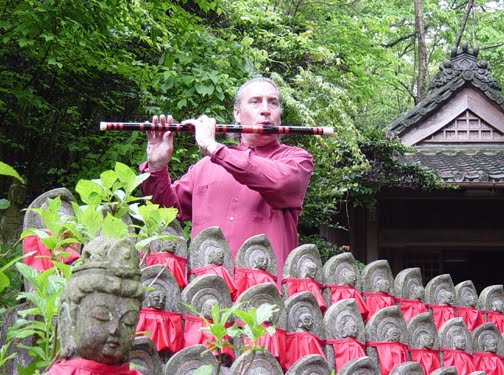
Next, we were off to four Buddhist Temple concerts in Gifu Prefecture. Here Gary is outside of Houfukuji in Kakamigahara City, not far from Nagoya. Inside, he played an evening concert lit only by the temple's candles and incense. Afterwards, the guests were treated to a shojin ryori (temple food, mostly vegetarian) meal prepared by Mrs. Nishibu (Rev. Nishibu's wife) and temple staff. Another temple concert was in the mountain town of Takayama at the historic Kokubinji Temple (founded in the 7th century.) After these concerts, we headed to my old town of Mashiko, where the annual Pottery Festival was going on. Gary played at the Mashiko Messe Ceramic Museum in front of the Hamada Shoji House. The next day, a performance held in a stone "kura" (storehouse) converted to a cafe made another great acoustic venue for Gary's flutes. It was a memorable trip and we have plans for another Japan in the near future!
For all ceramic-instrument music, check out the CD "Sacred Clay." Gary Stroutsos on wind instruments and Grammy-nominated percussionist Will Clipman on udu and other percussion instruments, all created by Olympia, WA clay artist Rod Kendall. Available through our website, www.mingei-wasabidou.com.

Mingei: Theory Aesthetics, Spirit; Shoreline Community College March 4, '06


This was a lecture/discussion and exhibit at Shoreline Community College just north of Seattle. Several items from our collection were on display: small furniture, lots of pottery, textiles, folk toys, etc. The discussion was meant to expose Yanagi Soetsu's "mingei biron" (Mingei Theory) to the local public. While many mingei discussions revolve around the objects themselves in an anthropological sense; the basis of mingei actually is centered on Yanagi's theories, many of which are rooted in Buddhist philosophy. It is this theory that brings to the light the possibility of bringing mingei out of the realm of the "Unknown Craftsman" of yesterday into that of the contemporary studio-artist. During the preview and intermission, soothing Okinawan folk music by played on shamisen by Mako. With an authentic Kumejima kimono displayed behind her, all we needed was an island breeze to make us feel like we were in Okinawa. See http://mingei-folkcraft.blogspot.com for more information on this event.

Mingei Open House Sale: Feb 24-March 19, '06


This was the Open House Sale & Exhibition that accompanied the lecture at Shoreline Community College. The postcard at left featured the following three items featured in the sale: Teacup by Shimaoka Tatsuzo (National Living Treasure,) ca. 1970's; Woodblock Print of Jar by Tomimoto Kenkichi (National Living Treasure,) ca. 1955; and a kasuri kimono from Kumejima Okinawa (designated a National important craft,) ca. 1960's.

Below is a wonderful tea cup attributed to Hamada Shoji, early 1970's.


Found In Translation: Asian Traditions in Contemporary Art; Nov-Dec '05


Found In Translation is an exhibition that I am very proud of. Held at TORA Gallery in the scenic Skagit Valley of Washington State, the show brought together over 40 contemporary artists from the US & Japan whose work has been inspired by Asian traditions. Feature artists inlcuded furniture maker Evert Sodergren (whose chairs are featured in the Smithsonian,) sculptor Gerard Tsutakawa (whose giant "Glove" adrons the entryway of the Seattle Mariner's Safeco Field,) textile artist Kikuko Dewa (whose great uncle is a Textile National Living Treaure in Japan,) and many more talented individuals. It also featured live performance calligraphy by Chiyo Sanada and contemporary koto music by Silk Strings. Duo En's koto & shakuhachi concert and haiku reading in Japanese & English. Please visit http://foundintrans.blogspot.com/ for plenty of photos and information. This was a lot of work and a lot of fun!


Voice of Flying Ink: Calligraphy by Meredith McPherson; Oct.'05.

This was a show I curated for friend and talented calligrapher, Meredith McPherson at Floating Leaves Tea House in Seattle. Meredith had long studied with master calligraphers in China, and has since had numerous showings of her work in the U.S. I've done a few solo shows of her work, and have also included it in a number of group shows I've produced. See more of her work and read more about her at www.zeninkart.com. Floating Leaves has since moved to smaller digs without a gallery or cafe space where they can focus on their primary mission, purveying high quality Taiwanese Oolong tea. See www.floatingleaves.com for the best Taiwan Oolong around.

Tougei Taisai at Tsubaki Jinja; August 21, 2005

I put together this event as a way to show appreciation and support for local potters and for my friends at Tsubaki Shrine; located in Granite Falls, WA. It's not unusual in Japan for a Shinto priest to come out and bless a kiln prior to an important firing. Here, we had potters come out to the shrine (the only one of its kind outside of Japan, we're lucky!) and be blessed by Reverend Koichi Barrish. Potters also had pieces blessed that were later sold at a fundraising event held on the shrine grounds. About 30 potters had work in the sale and about 50 attended the event overall. Flutist Gary Stroutsos performed an offering concert on all ceramic instruments created by potter Rod Kendall, of Olymia, WA. See a separate blog at http://sacredclay.blogspot.com/ for full details. See http://www.tsubakishrine.org/ for info on the shrine.

Thursday, May 19, 2005

Japan Craft Tours

Japan Craft Tours

WaSabiDou Antiques & Folk Crafts now offers guided tours of
Japan, custom tailored to your specific interests: i.e. folk crafts,
gardens, cuisine, spiritual or historic sites, etc. Of course, our
specialty area is folk crafts and sites related to the Folk Craft
Movement. In addition, short spiritual pilgrimages may be added on to
your tour at cost. We can't profit from this portion of your tour.
A sample 12-day itinerary might include the following sites and
activities: Tokyo; Japan Folk Craft Museum, Art Museums, Dining in a
"kura" (storehouse,) Dinner in a restaurant filled with original
storyboard paintings by Akira Kurosawa, and more....off to Mashiko,
pottery town with an estimated 400+ kilns for a visit to Shoji Hamada's
Mashiko Reference Museum, plus pottery galleries galore and a chance to
try your hand at throwing your own pot.....Kyoto; temple and garden
tours, excellent Zen Buddhist cuisine, museum home of potter Kawai
Kanjiro, and more...stay a night at a Buddhist monastery and learn
the connection between Buddhism and the folk craft
aesthetics...finish with a visit to Kamakura, home to more than
120 shrines and temples just an hour by regular train from Tokyo.
For those wishing a spritually and physically refreshing experience
prior to returning home, take a 2-day walking pilgrimage of the 33
Kannon Temples in the Kamakura area. You need not be a practicing
Buddhist to benefit from this short journey to deeply spiritual sites,
several hundred years old. But, a respect for the practice of
pilgrimage is necessary (vegetarian diet, giving alms, etc.) Your guide
is happy to discuss the history of the various sites visited, or
to quietly be your walking companion. As stated above, this
addition to your tour is at cost.
 
Tatsuo Tomeoka has several years experience as a professional
tour guide, mainly for Japanese guests visiting the United States and
Western Canada. Custom tours and translation services have been created
for business visitors, artists, architects, Buddhist clergy,
and travellers just wanting to shop till they drop! He has also
provided several tour experiences in Japan focusing on
mingei-related craft sites and Buddhist temples. He has lived and
worked in various cities and towns in Japan, including Mashiko, Tokyo,
Yokohama, and Kumamoto.
He currently resides in Seattle, Washington with his wife,
Apple; daughter, Shino Claire; and son Yumeji Clay.  
He looks forward to showing off some of his favorite spots in
Japan, and possibly discovering new sights, with you.
Remember, our tours are custom-designed and highly flexible (number
of travelers, dates, itineraries.) The best tour will be the
one that we create together!  

Monday, March 21, 2005

Dentou Kokeshi

Dentou, or "traditional," kokeshi hail from the northeastern part of Japan known as the Tohoku region. Tohoku is comprised of Aomori, Akita, Yamagata, Iwate, Miyagi, & Fukushima Prefectures. They are colorfully painted (or bare, in the case of one Nambu-kei kokeshi from Iwate) wooden dolls of female gender that have been around since at least the Edo Period (1600-1868) and are still produced and sold today at various hot spring resorts and other traditional production centers in the region.

Legends about the origins of kokeshi are difficult to prove, but they are thought to have possibly been a totemic type of stand-in for infants and children in old NE Japan. This area was at one time one of the most impoverished and environmentally harshest regions of the country. Infant mortality was high, possibly more so among females as we can assume that in this agricultural setting, males were valued more and better taken care of.

After a safe delivery, or a healthy upbringing, the doll could be desroyed by burning or tossing in a river. This was a common practice with other types of dolls in Japan known as 'amagatsu' (used by the aristocracy) and houko (used by commoners.) Still today, we can find 'kokeshi ohaka' (kokeshi cemetaries) at a few temples in NE Japan, where older, unused kokeshi dolls can be brought for burning. And, ritual burning at sea of dolls and children's toys is another practice still carried out in many parts of Japan.

What we do know for sure is that kokeshi were actual folk toys for children of Tohoku, which was also well known for itinerant woodcrafters, and the spare time in the long, cold winter months to pursue such craft works as weaving, dying, embroidery, woodworking, and clay/paper/wood doll making. As such, they are usually included in the genre of craft items known as "mingei," or folk craft.

Today, kokeshi are purchased by locals and tourists alike, mainly at the many hotspring resorts dotted around Tokoku that have kept this traditional craft alive, mostly passed down from father to son. Each locale has its own style, pattern, color combinations, etc. But, successive generations of kokeshi artisans have also been able to incorporate their own touches rather than merely copying their forefathers' work. By repeating the pattern of their ancestors through long apprenticeships and countless repetitions on a theme, the designs do eventually become their own. This reliance on what Folk Craft Movement founder, Yanagi Soetsu called the "Other Power" ('tariki' in the Buddhist sense) is what makes these dolls a link to tradition, as well as a contemporary product of aesthetic beauty.

Being the collectible item today that is produced and used mostly for display purposes, kokeshi can no longer be considered a "folk toy." However, the spirit of the artisan is what's important to me here. There is another version of kokeshi today called "creative," "modern," or "art" kokeshi. These are not bound by traditional designs and patterns, but are artistic interpretations by individual artists, creating a name for themselves. Dentou Kokeshi, though often signed by the artisan, are still representative first and foremost of their region and tradition.

Currently, I have available a large collection of vintage and new dentou kokeshi reaching back to the war years up to pieces purchased about 5 years ago. For most, I have been able to identify the maker, and where so have their birth or death date available from references as well. Please feel free to contact me with any questions or comments. Are you a kokeshi collector as well? Let's start a club!

Thanks for reading,
Tatsuo Tomeoka
WaSabiDou Antiques & Folk Crafts
tatsuo@mingei-wasabidou.com
(under construction) www.mingei-wasabidou.com