Monday, December 01, 2014

Thanksgiving 2014

Hope you all had a wonderful Thanksgiving; full of family, friends, and good food.
I usually like to do a course menu on special occasions, but this year we were fortunate to celebrate the holiday over several days at multiple locations. Still, I wanted to put my ideas for the year on a plate so we prepared small dishes at home throughout the 4-day weekend. Here's how they would appear in a single dinner menu, on dishes in our home collection.

Kousen (fragrant warm drink): Kuzuyu (Hot water, slightly sweetened, and thickened with kuzu starch) served two ways, scented with Yuzu, and with Pumpkin Pie Spices.
Tea cups - Zezeyaki, Shiga Prefecture. Kabazaiku (Cherry Bark) Tray; Kakunodate, Akita.


Mukozuke Course:
-Apple cider braised Turkey Thighs served on Steamed Chinese Bun with Cranberry Hoisin Sauce and Kaiware Daikon Sprouts. Plate by George Gledhill.
-Red Curry Kabocha (Japanese Pumpkin) Soup with Coconut Milk and Lime Juice. Sendai-nuri Lacquerware.
-Haricot Verts sauteed in Miso Butter, garnished with sliced Almonds. Porcelain Mukozuke Dish by Hanako Nakazato.


Wanmori Course:
-Clear Soup; Ground Turkey and Grated Apple Meatballs in Bacon Dashi, with Bunashimeji Mushrooms and Baby Bok Choy. Sendai-nuri Lacquerware.
-Sake: Momokawa Junmai Ginjo; Forest Grove, Oregon. Guinomi by George Gledhill. Mashiko-yaki Tokkuri.


Yakimono (Grilled Dish) Course: Pan-seared Sockeye Salmon on bed of Curry Creamed Spinach with Red Quinoa. Shino-glaze Dish by Kato Kozo.


Mushimono (Steamed Dish) Course: Chawan Mushi (Steamed Egg Custard) with Turkey "Oyster" (sotl'y laisse,) Carrot, and Shiitake Mushroom. Mashiko-yaki lidded bowl on small plate by Mika Sullivan.


 Rice Course:
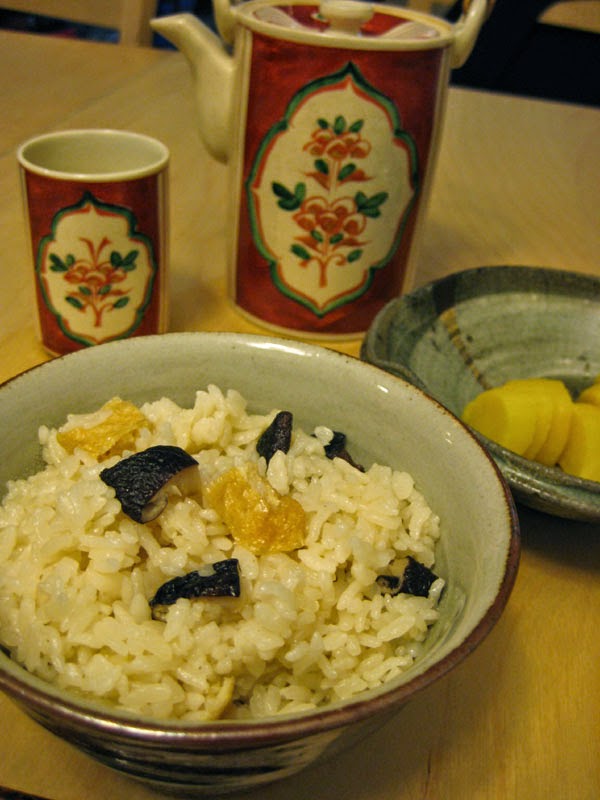
-Shiitake Gohan, seasoned rice with roasted Shiitake Mushrooms & Abura-age (Fried Bean Curd;) Mashiko-yaki Rice Bowl, Soeya Kiln.
-Tsukemono (pickled Daikon Radishes) on spouted bowl (katakuchi;) Mashiko-yaki, Yumito Kiln.
- Charaku Houjicha (Roasted Green Tea;) Kyo-Satsuma Tea Cup and Tea Pot.


Dessert Course: (Trio)
-Pumpkin Cheesecake Bar.
-Yuzu Ice Cream with Blueberry Dessert Wine (Samson Estate Winery; Everson, Washington.)
-Chocolate-enrobed Roasted Fig.


Tea Course:
Charaku Premium Organic Matcha. Bamboo-shaped Winter Tea Bowl by John Miller; Portland, Oregon.

Friday, March 14, 2014

10% of Tea & Book Sales to be donated to 3/11 Japan Relief.

Waves at Matsushima, one of a pair of screens, by Tawaraya Sotatsu, early 16th C.

It has been three years since the Great Tohoku Earthquake & Tsunami of Mach 11, 2011. Today, there are still an estimated 270,000 people who have yet to be able to return to their homes due to either physical damage of radiation evacuation. And this number doesn't even begin to touch the multitude of individuals, communities, and industries affected by this event. In truth; the physical, emotional, and financial health of the entire nation is in jeopardy. It's overwhelming to think of what can be done to solve the crisis, but grassroots groups of many kinds are making efforts to create solutions as best as they can on a small scale, and these tend to add up. One such group is Watari Ichigokko; a non-profit, volunteer group that provides assistance to those still displaced individuals, especially the elderly who make up a large portion of those affected.  I was introduced to this organization at the recent Smile for Japan fundraiser where I served and sold tea.

I'd like to continue to donate 10% of my retail tea sales (leaf tea and matcha) from Charaku Fine Japanese Tea and also 10% of book sales from WaSabiDou Antiques & Folk Crafts from March 11 to May 11, 2014 to Watari Ichigokko. Please help to support the cause. Hopefully, small changes can lead to big solutions.


Wednesday, March 12, 2014

Soma-yaki, Fukushima


Soma-yaki Tea Bowl. This Matcha Chawan (Tea Bowl) is one of a pair in my mother's house, and has an extra special significance to me this time of year. It's a souvenir bowl with the writing "Byakui Daikannon Sanpai Kinen" (Great White Kannon Pilgrimage Commemoration) written on the outside and an image of the Kannon (Goddess of Mercy) on the inside. It was probably made in the early 1950's. It's not the type of bowl that I would typically use for tea myself, as it is quite busy and decorative. It does, however, have great sentimental value in my family as a collectible of my grandmother's in Sendai, and most likely as something that my late uncle Yukio got in Soma County, Fukushima, where he worked. We don't know the whole story, but imagine that my uncle went on such a pilgrimage to the Great White Kannon statue (there's one in Sendai now, but back then the closest would probably have been in Takasaki, Gunma Prefecture.) The group, maybe fellow coworkers in Fukushima, had these commemorative bowls made as a momento of the trip. This is a common practice even today for groups to commission a ready-made craft item to be engraved or painted with details of a trip or meeting (the equivalent of T-shirts here in the U.S.) My grandmother was a devotee of Kannon-sama and she was likely gifted with these bowls by my uncle. When my mother came to the States, she was given these by my grandmother. One of the pair was broken and has been poorly repaired by my father. No one remembers for sure, but Mom think it may have been my carelessness as a baby that broke it (the first of many!) Due to the nuclear radiation, the potteries of Soma are no more, the village of Namie, where Soma-yaki was primarily made, badly damaged by the earthquake and evacuated by the radiation. When I hold this bowl in my hands; I feel great respect for a folk pottery tradition over 300 years old, deep sadness for the continued plight of those effected by the Tohoku Earthquake and Tsunami, but also warm compassion from the image of Kannon-sama that gives us hope for the future.                                       


Smile for Japan

On March 9th, I was privileged to take part in "Smile for Japan," a 3/11 (Japan Earthquake - Tsunami) fundraising benefit in Seattle. The event featured some wonderful music by a great variety of performers; from latin marimba, to jazz, to classical, to folk, and some Japanese tunes thrown in as well. There were also hand-made craft items and food (sushi & donuts, who doesn't like both of these?) sales to benefit the cause. I served and sold tea, donating a portion of the proceeds to the event. The recipient of Smile for Japan donations is Watari Ichigoco, a NPO in Miyagi Prefecture, which supports those dislocated by the earthquake & tsunami. It's been 3 years, and many (especially elders) are still in temporary shelters. Here's their FB page (Japanese)https://www.facebook.com/watari.ichigokko.
For more info on Smile for Japan, and some photos of the event, here's their FB page, https://www.facebook.com/events/639368139443860/?previousaction=join&source=1


I've decided to continue to try and raise funds by donating 10% my retail tea sales proceeds to Watari Ichigoco for the next two months, until May 11th.


Monday, February 03, 2014

New Pots from John Benn

We are pleased to announce that the work of a fine Pacific NW potter, John Benn, can now be found on our WaSabiDou website, and in our showroom. The work is all wood-fired and we recently posted about 30 pieces, which includes Tea Bowls, Sake Cups, Sake Bottles (tokkuri,) and a large Vase.
Here's a bit about John and his wife, Colleen Gallagher, who is also a wonderful potter, and some images of a few of the pots:

John Benn studied with F. Carleton Ball and Ken Stevens at the U. of Puget Sound in Tacoma, and with Howard Shapiro and Sandra Simon in the MFA Program at the School of the Art Institute of Chicago. In 1976, he built his first wood kiln. Now, he and his wife, Colleen Gallagher, make wood-fired pottery among the pristine forests of Harstine Island at the South End of Puget Sound in Washington State. John and Colleen have been professional potters for 27 years and currently fire two wood kilns, a salt kiln and a 25-ft hybrid-anagama  kiln, on their property.  The pots are formed from locally dug native clay clays, and their kilns are fueled with wood from the surrounding forests; such as fir, alder, madrona, cherry, and maple.  Typical firings are three or more days, creating works that are truly a combined result of both man and nature. Wood-firing gives both accidents and blessings, and it is in this imperfection that the beauty of their work is found. Their commitment to wood firing is obsessive and non-intellectual. In John’s word, “We discover our pots in addition to creating them.” Regarding his Chawan, Tea Bowls, John states, “More than the sum of its parts -- line, color, weight, texture -- it is hoped that the Chawan possesses something of the potter who made it. In use it may find life and allow others to feel the awe and mystery that I felt during its creation.”

Matcha Chawan - Tea Bowl

Matcha Chawan - Tea Bowl

Guinomi - Sake Cup

Guinomi - Sake Cup

Tokkuri - Sake Decanter

Kabin - Flower Vase

Matcha Chawan - Tea Bowl

Year-End Sweets from Tokara

This is a late post, but hopefully better late than never. We were fortunate to be around when Tokaragashi in Seattle was selling "nenmatsu wagashi" (year-end Japanese sweets.) Although they don't last long in our house, I fended off the family long enough to take a few pictures to share here.
Image these with a nice bowl of Charaku Matcha!


George Gledhill On-line Exhibition

We're pleased to be showing an on-line exhibition of nearly 200 pieces of the work of Pacific Northwest potter, George Gledhill.
Many of our WaSabiDou and Charaku friends have collected George's pots over the years through our two websites and through our Seattle showroom. The large collection will only be available to view at http://www.flickr.com/photos/110543685@N07/sets, or in the showroom by appointment. It features over 40 Tea Bowls, 60 Tea Cups, 25 Sake Cups, Vases, Dishes, Plates, Incense Containers, and more. Here's a preview of some of the items. Please have a look and let me know if you have any questions.

Black Raku Tea Bowl.
 Tall, WInter Tea Bowl with Crawling Shino Glaze.
 Shino Glaze Footed Sake Cup.
 Set of Small Dessert Dishes with Ladled Glaze.
 Porcelain Sake Cups with Engraved Buddhist Knot of Eternity.

Hotei-sama, God of Contentment and Happiness, Sculpture.

Wednesday, January 01, 2014

FIrst Bowl of Tea 2014


       Happy New Year 2014 (C.E.) / 2556 (B.E.) / Heisei 26 
                                     Year of the Horse 
                 Akemashite Omedetou Gozaimasu!

Appropriately, my first bowl of matcha this year was made in a bowl with an image of galloping horses (hashiri goma.) This horse painting in the style of the Kano School has a long history of adorning the wares of Soma in Fukushima Prefecture.

Best wishes for a Happy, Healthy, Peaceful, and Prosperous New Year.
From Tatsuo Tomeoka
Charaku Fine Japanese Tea / WaSabiDou Antiques & Folk Crafts

Sunday, December 22, 2013

Toji (Winter Solstice)


Yesterday, December 21st, was the Winter Solstice here (it's the 22nd in Japan.) We had our first snow this week, which seemed appropriate. Known as "toji" in Japan, the winter solstice is a time for traditional practices that are typically meant to ward off disease in the coming winter season. The most common is that of putting yuzu fruit into the bath to prevent catching colds in winter. Yuzu are a small, yellow citrus fruit that are unfortunately not available here in the Pacfic NW United States. Growing up here, my mother used to always put in the Satsuma Mikan (Satsuma Oranges, like a Clementine) that were imported from Japan in those days, specifically from Kagoshima Prefecture, whose pre-modern Provincial name was Satsuma. Although whole yuzu are used in Japan, we used to just throw in the peels and eat the oranges themselves. I try to keep this tradition going with my children. The Mikan these days are most likely grown in California, and we can also purchase yuzu shibori (yuzu juice) at an Asian market. I add a few drops of this just for the fragrance (and possibly for whatever magical powers these possess that created this tradition in the first place.)

I don't think anyone really knows where the tradition actually comes from, but a natural connection to Vitamin C certainly comes to  mind. Although this is done is many Japanese households still today, it is a somewhat dying tradition. In the past, when communal bathing was a public necessity, hot springs and public baths also dumped loads of yuzu into their baths to attract customers. I'm sure it's still done in some places. Another practice is to put azuki beans in the bath, for the same purpose. This one I haven't tried yet. If anyone has, and if it works, let me know. Happy Toji to all of you!

Saturday, December 21, 2013

Hatsu Yuki (First Snow)


Hatsu Yuki (First Snow.) Yesterday, we had our first snow of the season here in our corner of the Pacific Northwest (south of us in Oregon, they were already dumped on in record amounts a few weeks ago.) It was only a few inches, and gone too soon for the kids' liking, but snow at all is still magical. It transforms the landscape, and our emotions. I try to make it a tradition to take a bowl of matcha outside whenever we have a new snow.
On rare occasions when we have lots of snow, we try to build a yuki kamakura (snow hut) in which to light candles and take tea.

The bowl used yesterday was a Black Raku Chawan by George Gledhill. I thought the stark contrast of black on white would be interesting. I hope you are enjoying tea wherever you, are and in whatever weather.
Warm wishes for the holidays.
Tatsuo

Monday, December 16, 2013

Charaku Fine Japanese Tea at Tokara Japanese Confectionery - Dec. 15, 2013


   Once again I had the privilege to serve tea at Tokara Japanese Confectionery in Seattle, one of just a few professional wagashi-ya in America.  Once each month, on the third Sunday, Chef Tokara opens her shop to guests to enjoy a traditional Japanese sweet of the kyogashi variety and a bowl of freshly whisked Matcha. She also prepares a monthly selection of sweets for customers to order and pick up. The monthly set includes three seasonal wagashi.  This month's selections included: Suomi Mochi (pictured at top), a snowball-esque pillow of delicious sweet white bean paste enveloped in a blanket of soft mochi. Rice flakes decorate the outside, along
with a holiday-themed holly leaf made of bean candy.

-2nd image: Tea Bowls at the ready. - 3rd image: Charaku Teas for sale.

-Images below show sweets served with Charaku Teas.


-The next sweet was "Hatsu Yuki" (First Snow,) made from Black Sugar and Azuki Bean Paste, and topped with rice wafer flakes to      create an image of the first snowflakes on the ground. Hagi Ware Tea Bowl with Craling Glaze.


-The third sweet was a "Soba Manju." Soba is Buckwheat, and the Red Bean paste is covered in a flaky crust of buckwheat cake. Black Raku Tea Bowl by George Gledhill.

For those guests wishing to partake of a sweet with a bowl of matcha, the featured sweet this day was a Castella Cake, the sweet introduced by Portugal in the 17th Century. It was revolutionary at the time to use eggs and flour in sweets, and this treat has since become a Japanese standard. Shino Tea Bowl by John Miller, Sweet Plate by Mika Sullivan.
 On this day, Chef Tokara also created a line of "Casual Sweets" for a fund-raising even at the Taoist Studies Institute down the street. These sweets were more of the "manju" type of sweet.

Here is a "Dorayaki," chunky red bean paste sandwiched between two mirin-sweetened pancakes. Mashiko-yaki Kyusu (Tea Pot,) Sweet Plate by Mika Sulivan.


"Kuri Manju" (Chestnut Bun) with chestnuts & white beans in a chestnut-shaped bun.  Tea Pot and Sweet Plate by Mika Sullivan, Kyo-yaki Guinomi (Sake Cup.)
 "Bolo de Chika" is a creative fusion of a Shortbread Cookie filled with Azuki Bean Paste mixed with Cream Cheese.  Yummm.
White Shino Yunomi (Tea Cup.)


 This last sweet is Chef Tokara's Miso Mochi Bar, a sweet rice flour bar flavored with savory miso and topped with pine nuts, sesame and poppy seeds. Porcelain Mug by Hanako Nakazato. Sweet Plate by George Gledhill.

Sunday, September 29, 2013

A Single Shard

It's been a nearly nightly ritual since both of our children were born to read to them before bedtime. We just finished this book, "A Single Shard" by Linda Sue Park. My kids have patiently endured many a gallery exhibit, pottery show, or studio open house but they usually need to be bribed with ice cream to make it patiently through any of these for the proscribed amount of time. This book about a potter in 12th Century Korea, however, held their interest from start to finish. And, they learned a bit of pottery history as well.

I've yet to post any kind of a book review here; and since I'm no literary critic to begin with, this will not be the first. Instead, this will just an endorsement of a book that I think will appeal to those interested in pottery, Korean pottery, pottery history, or just a well-written story for children of all ages. I enjoyed reading it for myself just as  much as I enjoyed reading it for my children, who are eight and ten. The characters jumped off the page so vividly for me that I felt as though I was watching a movie (and I'm quite surprised that a movie has yet to be made from this story.) It's a story that could be translated into many cultures and many crafts, even though it is specific to this period in Korean history.

I don't want to spoil the story for anyone, so I won't describe the plot in any detail. I'll just do what the publisher did and quote the inside jacket teaser page:

    "Tree-ear was so called after the mushroom that grew on tree trunks without benefit of parent seed. A good name for an orphan.
    Foraging in the fields and on rubbish heaps, and sharing the food with his friend Crane-man, used to be enough to fill Tree-ear's days. But now all Tree-ear wants to do is watch master potter Min at work.
    Ch'ulp'o is a potters' village, famous for delicate celadon ware, and Min is the most brilliant of all the potters in Ch'ilp'o. He is also known to be short-tempered. Even so, Tree-ear is drawn irresistibly to Min's workplace. He is fascinated by the miracle of the potter's craft and dreams of making a pot of his own someday. His quest leads him down unexpected paths, with hazards and rewards beyond imagining.
    This account of a creative spirit on its journey toward fulfillment is set in twelfth-century Korea, where the course of human destiny could be determined by a single celadon shard."

The author, Park, is a Korean-American writer of a number of children's books that have a historic or cultural backdrop to them. "A Single Shard," published in 2001, was awarded the Newberry Medal by the Association for Library Service to Children , recognizing it as a "most distinguished contribution to American literature for children. I also recall my daughter telling me a few years ago that a good book was read to the class a few years ago about Africa called "A Long Walk to Water." This NY Times best seller was another of Park's novels, and tells the story of one of the Sudanese "Lost Boys" of the 1990's.  In other words, she's a good writer. Even if you're not a pottery nut like me, you can't go wrong with this one.

Saturday, September 07, 2013

POTS IN ACTION III - SUMMER '13


We recently hosted a birthday dinner for good friends and brought out some of the pottery collection for a Summer menu inspired by local, seasonal ingredients (many from the birthday boy's own garden) and Japanese kaiseki-style courses. I say "kaiseki-style" in that my food doesn't really compare to true Kyoto Kaiseki Cuisine. It just wants to be that when it grows up. It's the end of the summer in the Pacific Northwest, and we're been enjoying the remaining days of long daylight, warm sun on the tomatoes, the last of the berries, and the first corn harvests. It's a great time to select from a wide variety of ingredients.


Kumidashi Course: 
Not quite an appetizer, the kumidashi course is just a welcoming opener. Often a fragrant beverage, or as simple as warm water to take the chill off during the winter months; I chose this time to serve a chilled watermelon and shiso soup. The vessels are vintage era Japanese porcelain demitasse cups. They show images of the flowers of different seasons such as iris (late spring, early summer,) wisteria (summer,) chrysanthemum (fall,) and winter peonies. These delicate cups are probably Kutani-yaki from the early-mid 1900's.
Also served was mizudashi karigane-cha,  cold-infused karigane (stems of Gyokuro) tea. This is one of our popular Charaku teas throughout the year, but especially now as it infuses well both hot & cold. Served in stemware, along with the porcelain demitasse, it is a elegant diversion to the mostly stoneware dishes to follow in the rest of the meal.


Mukozuke Course:
The mukozuke dish here is replaced by another unexpected piece of glassware, a vintage cut-crystal martini glass with a bamboo motif.
It contains a small salad of NW spot shrimp with avocado, dressed simply in light soy sauce, lime juice, and freshly grated lime zest.
The glass gets replaced later by an actual mukozuke dish with which to eat the rest of the meal.  


The remainder of the mukozuke course is comprise of a small bit of kaiseki rice (rice cooked with not only water, but also some sake and a small bit of salt) and miso soup. The soup today is white miso soup with pureed fresh corn from Small's Farm in Ferndale, WA. From the same farm is a round of dashi-simmered zucchini, topped with a dab of karashi Japanese mustard. The rice bowl is Kyo-yaki with a floral motif, and the soup bowl is Sendai-nuri (black lacquer ware from Sendai in NE Japan.)


Yakimono (Grilled Dish) Course:

On a vintage Mashiko-yaki plate with a Mt. Fuji motif, painted by Minakwa Hiro, was served a simple Beef Tataki dish with homemade ponzu dipping sauce. The plate is not necessarily seasonal, but it was a nod to the recent announcement of "Fuji-san" being named a UNESCO World Heritage Site.
The beef was "Kobe Beef" from Snake River Farms in Idaho. I say Kobe in quotations because although it is marketed as Kobe Beef, it is technically American Wagyu and not really from Kobe, or Hyogo Prefecture, from where true Kobe Beef hails. Still, it's some of the best beef we've had in America, and we're lucky that our local market carries it a few times a year and that this week was one of those times. Simply seared on the outside, and left rare in the center, it was then marinated in a mixture of sake and soy sauce for about an hour. It served with a citrus-soy dipping sauce with condiments such as green onions, grated daikon radish, and chili. The vessels here are a half round of green bamboo, and some simple local pots, the pitcher on a karakusa (Chinese grass)- motif saucer.


Sake is introduced with this course, and this meal's offering was "Tochigi Oni." As we used to live in Mashiko, which is located in Tochigi Prefecture; I thought it appropriate. It is also very smooth, and drinks well at room temperature. The guinomi in the foreground is a slip-trailed Onta-yaki piece. Those pictured in the group are (L-R): a warade (wheat straw) motif cup by local potter, Mika Sullivan; the Onta-yaki cup, a tall-handled bajyohai (cup for drinking sake on horseback!) of Shodai-yaki in Kumamoto, a red-glazed & slip decorated piece by an apprentice of Kawai Kanjiro, and a zogan-inlay guinomi by the late National Living Treasure, Shimaoka Tatsuzo.


Azukebachi Course:
This course left at the table was a another summer salad. This one was made with golden cherry tomatoes from our and our guests' garden, dressed in a mixture of freshly grated cucumber (also from our friends's garden) and daikon radish, plus lemon juice & salt.
It's very simple, but really exudes the flavor of the season maybe more that any other dish. It tastes and smells like harvesting tomatoes from your own back yard.
The bowl is a piece from the 1980's by Seattle potter, Liza Richardson. In Japan, it would be considered a donburi, but also works very well with salads and fruit. The floral pattern around the interior rim was perfect for this dish. Liza is someone with whom I used to work, but have lost track of over the years. We got many fine pots from her, and they are still used regularly in our home after all of these years. I hope to find her again!


Hassun Course:
The hassun course typically has two small items, one from the land and one from the sea, with which to enjoy a last cup of sake with the host.
The item from the sea is often something as simple as a few slices of smoked fish. In this case, I broke the rule and substituted something with a similar taste and mouthfeel, Prosciutto di Parma.  We have a good source for Italian & American prosciutto, as well as Serrano Ham from Spain, just north of us at Old World Deli in Bellingham.  I paired these with home-made Strawberry Conserves, with local favorite Sakuma Brothers Farm late-season Albions, topped with a drizzle of Balsamic Vinegar.The plate is an irregular-shaped dessert plate by an Orgeon potter, and decorated with summer dragonflies.

For the final rice course, I instead served cold noodles, a hot summer favorite. These noodles are cha-soba, green tea flavored buckwheat noodles. These are taken in small mouthfuls, dipped quickly in a soy and dashi broth, and then slurped noisily. The dipping cups are authentic soba choko, Imari ware from the mid-Edo Period (1600-1868.) Porcelain, with underglaze gosu (cobalt) blue brushwork.
The takuan pickles usually served with rice are substituted with kombu-pickled Beets, also from Small's Farm. I pickled these with kombu and rice vinegar for just a day to keep the fresh beet flavor and crispness. The dish is a small Onta-yaki plate with a combed design running through the glaze. I picked up these little dishes on a visit to Sarayama back in 2001, and they have been handy favorites for all kinds of side dishes since then.


For the dessert course, came the actual Birthday Cake. This was an idea I've had for a while and finally got to try out. It's a kare-sansui (dry landscape) garden made from cake, chocolate truffles, and matcha. The cake is a white cake, flavored with kuro goma (balck sesame) paste, then crumbled finely and dried to resemble raked sand. The "stones" are handmade chocolate truffles, and they are surrounded by freshly sifted matcha "moss." I enjoy making themed birthday cakes for my children, and this was a first attempt at a cake an adult who has spent time in Japan might appreciate.

 While we might enjoy sipping matcha contemplating a dry garden at a Zen temple in Japan, this matcha was meant to enjoy while "eating" the garden! As always, there were a variety of bowls for our many guests, but these two I thought best represented the season. The top bowl is a hira-chawan (wide tea bowl,) meant for summer use, by Sachiko Furuya. She excels in her use of bamboo ash glaze. This one has a mixture of Shino and take-bai (bamboo ash) glazes. We carry lots of her work on our WaSabiDou site. The other is an aohagi (blue Hagi) nodate chawan. Nodate tea bowls are small and can be used for outdoor use, such as on a summer picnic.


 There is rarely a shortage of desserts in the Tomeoka household, and had a few this day as well. We had a baked Peach Cake, with fresh Sun Crest Peaches from Eastern Washington. The peaches in the filling were marinated in Moscato Arancio, an American Orange Muscat Port, from Creekside Cellars in Boulder, Colorado, then roasted to concentrate their flavor and juices, thus reducing the sogginess often associated with this cake. The plate is another plate by Liza Richardson. The colorful pastel glazes look just as though the plate is decorated with pansies, that are revealed with each slice. Individual serving plates are by Mika Sullivan.


This was served with Lavender Ice Cream, home made by our guests, which was churning away on the front porch during dinner.
Washington State has a number of lavender farms, including a few on nearby Whidbey Island and on San Juan Island. Across the Salish Sea (Puget Sound) in the town of Sequim, one of the largest lavender festivals in the country takes place at nearly a dozen farms. This ice cream left a final taste & memory of a NW summer in all of our mouths. The dish is a porcelain mukozuke dish by Karatsu & Maine potter, Hanako Nakazato, whose work carry at WaSabiDou.

The last beverage was non-caffeinated and served in simple Mashiko cups. This was Natamame-cha (Sword Bean Tea) sent from Japan by a friend whose relatives are bean farmers and produce this bean, along with Kuromame (Black Beans.) They are in the Tamba region of Hyogo Prefecture, well-know for both of these beans. Currently, natamame-cha is enjoying wide popularity in Japan as a health drink.  It was a calming way to end a meal with good friends. I couldn't think of a better way to enjoy the end of another season.